Zeiss Lumera 700 Manual Dexterity
Choose Language.AbstractMany studies address cell migration using in vitro methods, whereas the physiologically relevant environment is that of the organism itself. Here we present a protocol for the mounting of Drosophila melanogaster embryos and subsequent live imaging of fluorescently labeled hemocytes, the embryonic macrophages of this organism. Using the Gal4-uas system 1 we drive the expression of a variety of genetically encoded, fluorescently tagged markers in hemocytes to follow their developmental dispersal throughout the embryo. Following collection of embryos at the desired stage of development, the outer chorion is removed and the embryos are then mounted in halocarbon oil between a hydrophobic, gas-permeable membrane and a glass coverslip for live imaging. In addition to gross migratory parameters such as speed and directionality, higher resolution imaging coupled with the use of fluorescent reporters of F-actin and microtubules can provide more detailed information concerning the dynamics of these cytoskeletal components.
Preparation. Obtain appropriate Drosophila lines containing a hemocyte-specific Gal4 driver (e.g. Srp-Gal4 2) and a genetically encoded fluorescent reporter under UAS control (e.g. Flies homozygous for srp-Gal4, uas-GMA 3 or crq-Gal4,uas-GFP 4, 5 are particularly useful for imaging purposes (n.b. GMA is GFP fused to the actin-binding domain of moesin); see below for a discussion of the range of Gal4 drivers and uas constructs available (the Bloomington Stock Centre contains a wide variety). Typically genetic crosses are carried out such that mutant alleles are balanced using fluorescent balancers CTG or TTG 6, with Gal4 drivers and uas constructs carried on alternative homologous chromosomes.
This makes it possible to select homozygous mutants on the basis of absence of CTG/ TTG-associated GFP fluorescence (this is done at stage 2.11). Amplify stocks and place flies in a laying cage with an apple juice agar plate 7. The flies need at least two days to acclimatize to the laying cage before enough embryos begin to be laid.
In general twenty flies of each sex should be sufficient to generate enough embryos for imaging but it should be noted that different lines have differing degrees of fertility. We use 55mm Petri dishes that fit into the bottom of a plastic beaker, punctured at its base to allow airflow. The exact means of embryo collection is unimportant, but the timings are critical in order to collect correctly staged embryos. Collect embryos from an overnight apple juice agar plate maintained at 25°C or from a timed plate.
For the latter we typically allow the flies to lay on a pre-warmed plate for 4 hours, before removing the plate and placing it at 18°C for 15-16 hours prior to mounting of embryos; this provides embryos from late stage 12 through to stage 15 of development. An overnight plate contains a greater diversity of stages but offers the advantage of higher levels of fluorescent reporter expression in hemocytes due to a longer period of time at 25°C as the Gal4-UAS system is temperature sensitive.Procedure. Dislodge embryos from the apple juice agar plate using a small amount of water and a soft-tipped paintbrush.
The most important elements of this procedure are the selection of healthy embryos with clearly labeled hemocytes and to mount them carefully without damaging them. Once the embryos are in the halocarbon oil they are resistant to dehydration and once mounted can be imaged for several hours. In our hands we can image hemocytes for three hours, with negligible dehydration of the embryo or obvious photo-damage, taking a z-stack of images every three minutes on our Zeiss LSM510 confocal microscope with a 40X objective. Since hemocytes are highly dynamic there may a trade-off between spatial and temporal resolution: if a very high-resolution image is needed the hemocyte and structures within it may move during the scan.
The precise details of how images are subsequently collected will be determined by the experimental questions to be addressed.We typically use uas-GFP or uas-GMA 3 to label hemocytes; uas-GMA is particularly useful since, in addition to marking hemocytes, it provides a read-out of actin filament dynamics. Other uas constructs may be used to probe hemocyte behavior: for example uas-cherry constructs 9 can be exploited as alternative fluorophores or uas-tau-GFP 10 could be used to visualize the microtubules within a hemocyte. Uas constructs with a nuclear label may be particularly valuable for automated tracking of hemocyte movements (Figure 2E-F). Two-color imaging is also possible (e.g. One can label both the actin and microtubule cytoskeletons using uas-cherry-moesin and uas-tau-GFP, respectively, under the control of a hemocyte-specific Gal4 driver).
As previously mentioned, a key determinant in live imaging of hemocytes is the Gal4 driver employed: as regards to current hemocyte-specific promoters srp-Gal4 2 crq-Gal4 11 pxn-Gal4 4, with only srp-Gal4 sufficient to label hemocytes when heterozygous, whereas at least two copies of crq-Gal4 or pxn-Gal4 are needed to observe hemocytes live. Nonetheless optimal imaging with srp-Gal4 requires homozygosity (or the presence of an alternative Gal4 driver).By following hemocytes live in this way it is possible to study their developmental dispersal from the head 8 and observe how they interact with the cues that pattern this process, deposit matrix and engulf apoptotic corpses. Hemocytes also represent an interesting system with which to probe the machinery of cell migration; by examining the migration of hemocytes in embryos that lack components of the actin or microtubule cytoskeletons it is possible to understand their in vivo function more clearly (e.g.
Rho GTPases 4, 12). Exploitation of uas constructs to label these cytoskeletons provides yet more detailed information on their regulation.We have modified this technique to probe hemocyte behavior in a variety of contexts such as their responses to laser-induced wounds4 and injection of fluorescently labeled bacteria 13. Furthermore this method can easily be adapted to image other cell types by choosing different Gal4 drivers. For example we have previously imaged dorsal closure using epithelial Gal4 drivers 14, 15. The application of this technique to other cell types is limited by the strength of the Gal4 driver, the position of the cells to be imaged within the embryo and the type of microscope used for imaging; multiphoton confocal microscopes enable the user to image cell behavior deep within the embryo (e.g. Germ cell transepithelial migration 16), whereas conventional confocal microscopes are unable to reach these depths (this is why we image along the ventral midline where hemocytes are very superficial, trapped between the developing ventral nerve cord and epidermis).The strength of this protocol is that it provides an environment to maintain embryos in a healthy condition for live imaging.

While a degree of manual dexterity is required to position the embryos, it is an easy technique to master and quickly gives reproducible results and can easily be modified using different Gal4 drivers and uas constructs to probe many different aspects of hemocyte biology. Additionally, the protocol is not restricted to hemocytes since the use of alternative Gal4 drivers enables the behavior of other tissue types to be analyzed.Subscription Required. Please recommend JoVE to your librarian. AcknowledgmentsThis protocol has been developed through our work within and in collaboration with the laboratories of Paul Martin and Antonio Jacinto. We thank the Bloomington Stock Centre for its excellent service and the Drosophila community for continuing to share fly lines.
BS is currently funded by a BBSRC project grant. WW is funded by a Wellcome Trust Career Development Fellowship. Materials NameCompanyCatalog NumberCommentsCell strainerBD Biosciences35235070μm poresHalcarbon oil 700Sigma-AldrichH8898Lumox/Petriperm dishSarstedt Ltd96077305References.
Brand, A. H., Perrimon, N. 118, 401-415 (1993).
Zeiss Lumera 700 Manual Dexterity System
Bruckner, K. 7, 73-84 (2004). Dutta, D., Bloor, J. W., Ruiz-Gomez, M., VijayRaghavan, K., Kiehart, D. 34, 146-151 (2002).
Stramer, B. 168, 567-573 (2005). Wood, W., Jacinto, A. Nat Rev Mol Cell Biol.

8, 542-551 (2007). Halfon, M.
34, 135-138 (2002). Sullivan, W., Ashburner, M., Hawley, R. Drosophila protocols.
Cold Spring Harbor Laboratory Press, Cold Spring Harbor. (2000). Tepass, U., Fessler, L. I., Aziz, A., Hartenstein, V. 120, 1829-1837 (1994). Millard, T.
H., Martin, P. 135, 621-626 (2008). Doerflinger, H., Benton, R., Shulman, J. M., St Johnston, D. 130, 3965-3975 (2003). Olofsson, B., Page, D.
279, 233-243 (2005). Paladi, M., Tepass, U.
Zeiss Lumera T
117, 6313-6326 (2004). Vlisidou, I. 5, e1000518-e1000518 (2009).
Jacinto, A. 10, 1420-1426 (2000). Wood, W., Jacinto, A.
Methods Mol Biol. 294, 203-210 (2005). Kunwar, P.
183, 157-168 (2008).Comments 1 Comment.
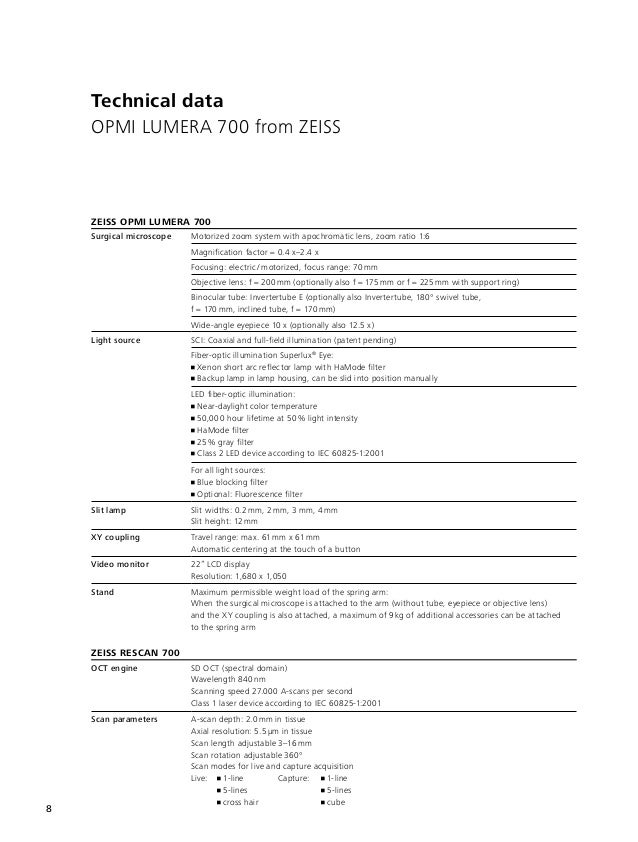
Zeiss opmi-lumera700 rescan 700 microscope.1.OPMI LUMERA 700 from ZEISSA new dimension in visualizationNow withintegratedintraoperativeOCT.Even if a scene is very familiar, evenif it is clearly visible in front of us;there are times when we wish wecould see more: To visualize thingsfrom a different perspective, to gainadditional insights.Well, now you can.There are timeswe’d like tosee more2.Equipped with ZEISS RESCAN 700,ZEISS OPMI LUMERA 700 takes surgicalmicroscopy to a whole new level withintegrated intraoperative OCT. Visualizetransparent structures of the anteriorand posterior segment directly in theeyepiece.